
Definition
The sigma chord (σ) is a five-note chord defined by Lorenzo Frizzera as a musical structure endowed with an exceptional combinatorial property: within it appear all the possible distances of the spatial interval vector within the octave, with the exception of the tritone.
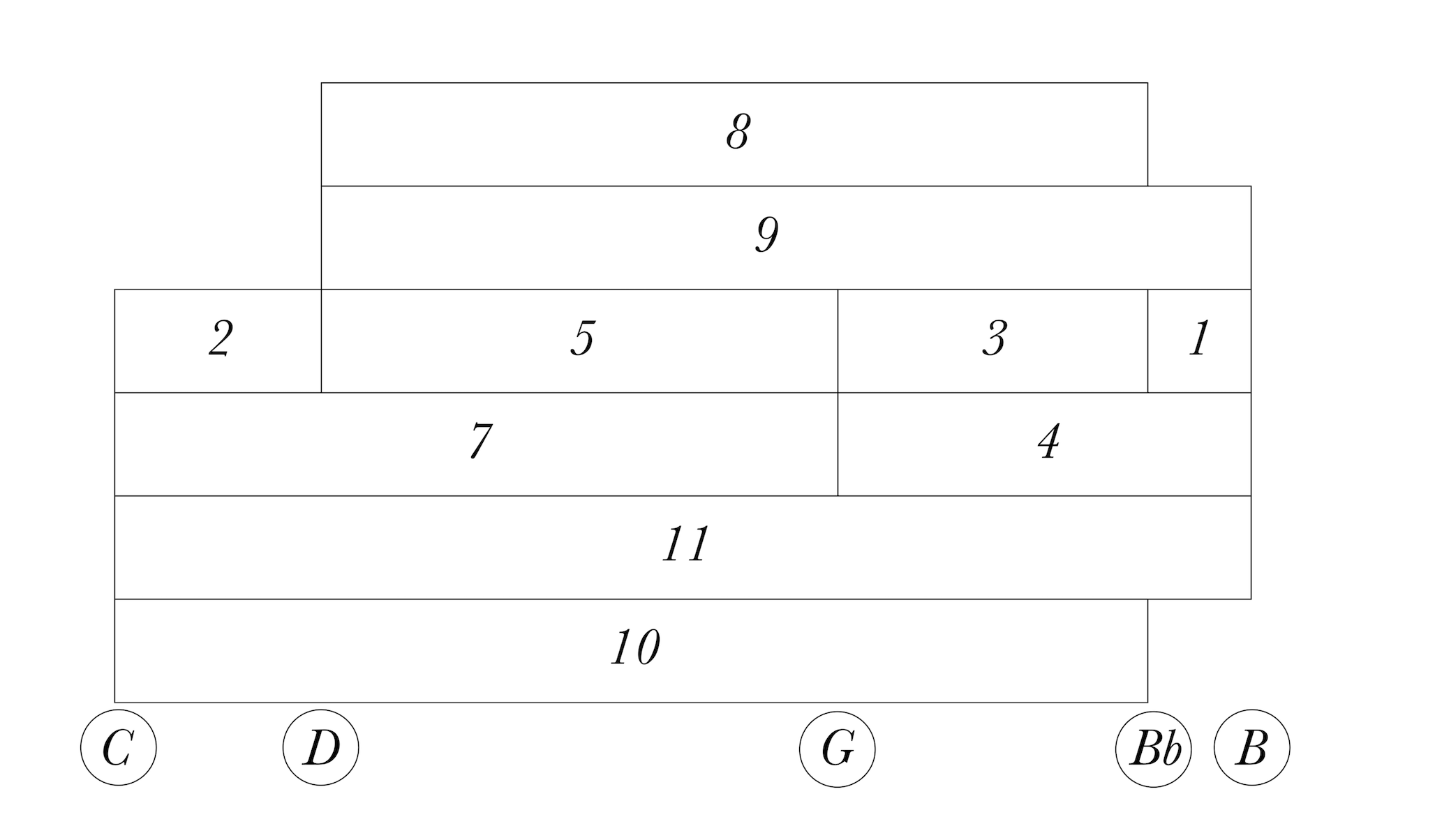
Example of a sigma chord of C, consisting of the notes C, D, G, B♭ and B.
For this reason it is a form of maximum informational density obtained with the minimum number of sounds — a small structure capable of containing almost the entire field of fundamental intervallic relationships.
Its name derives from Sigma Orionis, a stellar system in the constellation Orion formed by five main stars, adopted as a symbolic image of the relationship among the five notes of the chord.
The sigma chord is the largest of the three main musical zygotes of the SEA system; for the relationship among the alpha chord, epsilon chord, sigma chord, Golomb rulers and all-interval chords, see the same entry.
Root Note and Chord Structure
In terms of degrees relative to the root note, the structure of the chord is:
1 – 2 – 5 – ♭7 – 7
The name of each sigma chord derives from its lowest note, which constitutes its root and structural reference point. For this reason, the set C–D–G–B♭–B is called the sigma chord of C.
Exemplary Form and Catalogue Form
The form 0 2 7 10 11 represents the exemplary form of the sigma chord starting from its root note. In the catalogue of spatial interval vectors, however, the same structure may also appear in normalised form or through its mirror chord.
For this reason, apparently different forms may belong to the same vector class, provided they share the same spatial interval vector:
[1 1 1 1 1 0 1 1 1 1 1]
In this sense, the identity of the sigma chord depends not only on the concrete succession of notes, but on its fundamental intervallic property: containing each of the possible distances within the octave exactly once, with the exception of the tritone.
Intervallic Property
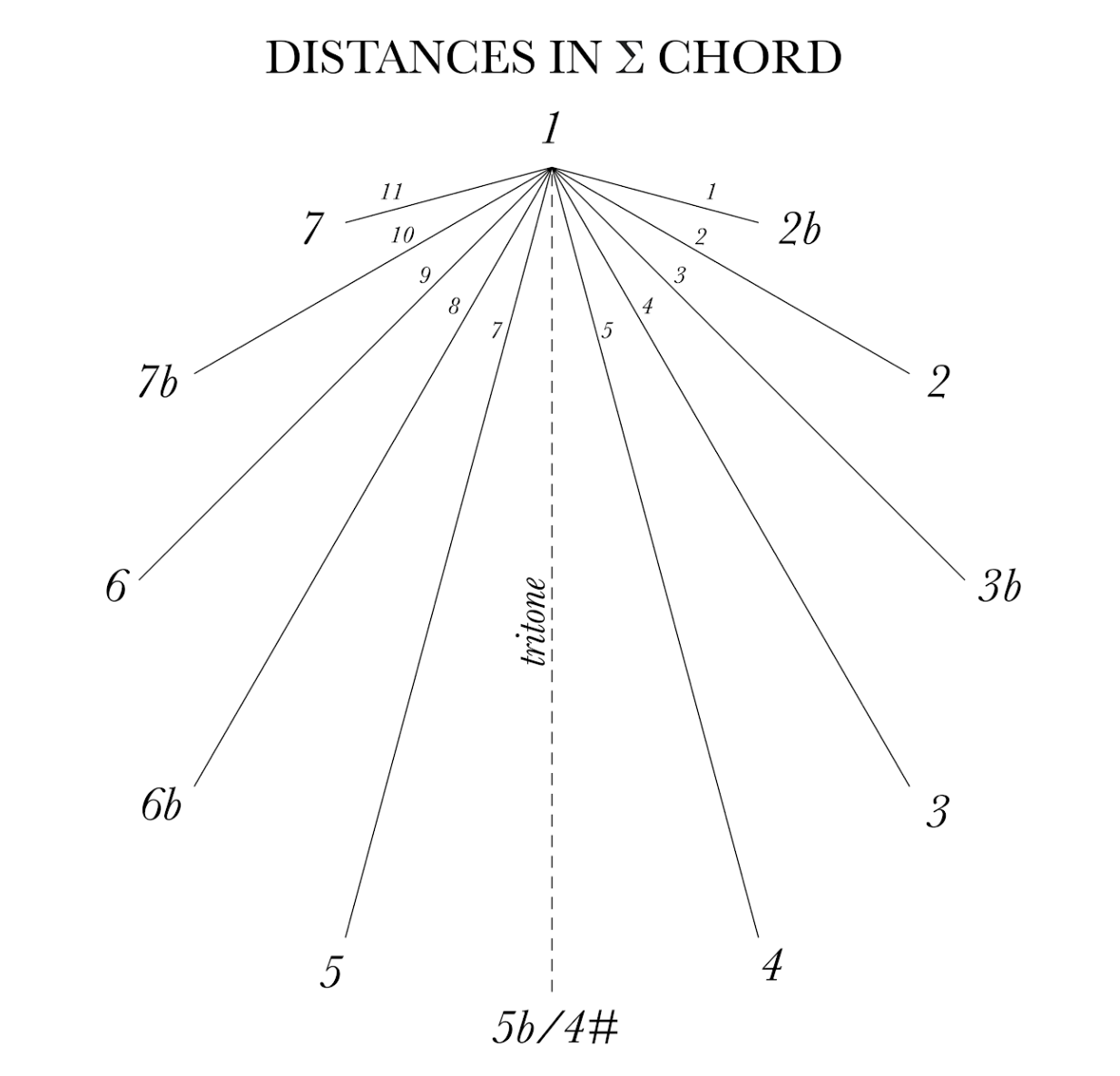
The intervallic relationships generated by its five notes cover each of the distances within the octave exactly once, with the exception of the tritone alone. In the case of the sigma of C, formed by the notes C, D, G, B♭ and B, one indeed obtains the ten intervals corresponding to 1, 2, 3, 4, 5, 7, 8, 9, 10 and 11 semitones, while only the interval of 6 semitones is absent.
| Semitones | Interval | Note pair |
|---|---|---|
| 1 | minor 2nd | B♭–B |
| 2 | major 2nd | C–D |
| 3 | minor 3rd | G–B♭ |
| 4 | major 3rd | G–B |
| 5 | perfect 4th | D–G |
| 7 | perfect 5th | C–G |
| 8 | minor 6th | D–B♭ |
| 9 | major 6th | D–B |
| 10 | minor 7th | C–B♭ |
| 11 | major 7th | C–B |
Mirror Chord
Like every other structure in the Catalogue of Spatial Interval Vectors in the Chromatic System, the sigma chord also possesses a mirror chord, obtained by specularly inverting the arrangement of its distances relative to the root note.
In the case of the sigma of C, formed by the notes C–D–G–B♭–B, the corresponding mirror chord is C–D–F–A–B♭, that is, the structure 0 2 5 9 10.
The two chords share the same spatial interval vector and the same combinatorial completeness, but present a specular internal arrangement of distances.
Twin Chord
Alongside the sigma chord there exists a second five-note chord endowed with an equally exceptional combinatorial property, often indicated as its twin chord. Its structure is:
1 – 2 – 5 – ♭6 – 7
and, in the fundamental case of C, corresponds to the set:
C–D–G–A♭–B
Its mirror chord is:
C–E♭–E–A–B
Vector Symmetry
The spatial interval vector of a sigma chord is the following:
[1 1 1 1 1 0 1 1 1 1 1]
This configuration is symmetrical with respect to its centre, constituted by the absent tritone. The five distances below the tritone, from 1 to 5 semitones, find a specular correspondence in the five distances above it, from 7 to 11 semitones, all present exactly once. The single zero value occupies the central position of the vector, corresponding to 6 semitones. In this sense, the sigma realises not only a near-completeness of intervals, but an ordered near-completeness arranged around a central void.
The twin chord, while sharing with the sigma the principle of maximum variety without repetition, does not possess this same symmetry. Its spatial vector is:
[1 1 1 1 1 1 1 1 1 0 1]
In this case the single zero value does not occupy the central position, but a lateral one, corresponding to the interval of 10 semitones. The result is a structure that is still exceptional from a combinatorial standpoint, but asymmetrical in the distribution of distances.
Uniqueness
The uniqueness of the sigma chord depends on the convergence of multiple exceptional properties in a single structure. First of all, it achieves a very high degree of intervallic completeness with a minimum number of sounds: with only five notes it indeed generates ten internal relationships, covering all distances within the octave with the sole exception of the tritone. In this sense, the sigma represents an extreme form of economy of musical material.
To this near-completeness is added a second decisive element: each interval appears exactly once. The sigma not only contains almost all possible distances, but contains them without any redundancy. No relationship is repeated, and the maximum degree of variety is thus accompanied by the minimum use of sonic material.
A third distinctive property is the symmetry of its spatial interval vector, in which the single zero value occupies exactly the central position, corresponding to the tritone. The distances from 1 to 5 semitones find a perfect specular correspondence in the distances from 7 to 11 semitones. The result is a structure ordered around a central void, which is not a simple absence but a formal condition of its symmetry.
Considered together, these properties make the sigma a unique configuration: minimal in note count, maximal in intervallic variety, free of internal repetitions and endowed with a vector symmetry centred on the absence of the tritone. It is this convergence of completeness, economy, non-redundancy and symmetry that distinguishes the sigma chord from every other structure in the 12-note chromatic system.
Origin of the Name
The name of the sigma chord derives from Sigma Orionis, a stellar system located in the constellation Orion and formed by five main stars. Lorenzo Frizzera chose this name for the symbolic correspondence between this astronomical configuration and the structure of the chord, also formed by five notes.
Role in the SEA System
In the broader context of the SEA system, the sigma chord constitutes the most extensive level of a hierarchical structure that also includes the alpha and epsilon chords. In this system, alpha is contained in epsilon, and epsilon is contained in sigma, according to a progressive expansion of intervallic content.
For a general treatment of this theoretical framework, see the entry Zygote Chords.
Related Entries
Spatial Interval Vector
Catalogue of Spatial Interval Vectors in the Chromatic System
Zygote Chords
Alpha Chord
Epsilon Chord
Tritone