
The grammar of kudamaf rests on a single principle: nothing agrees and nothing is irregular. There is no gender, number, declension, auxiliaries, or defective verbs. Every piece of information that earthly languages spread across several words — person, tense, mood, aspect — sits here in a single place, always the same one.
The root and the three suffixes
Every word is born from a bisyllabic root ending in a consonant. The bare root is already the noun; from it, always and without exception, three forms are built:
| form | suffix | example |
|---|---|---|
| noun | bare root | zem — beginning |
| verb | -at | zemat — to begin |
| adjective | -en | zemen — initial |
| adverb | -ez | zemez — initially |
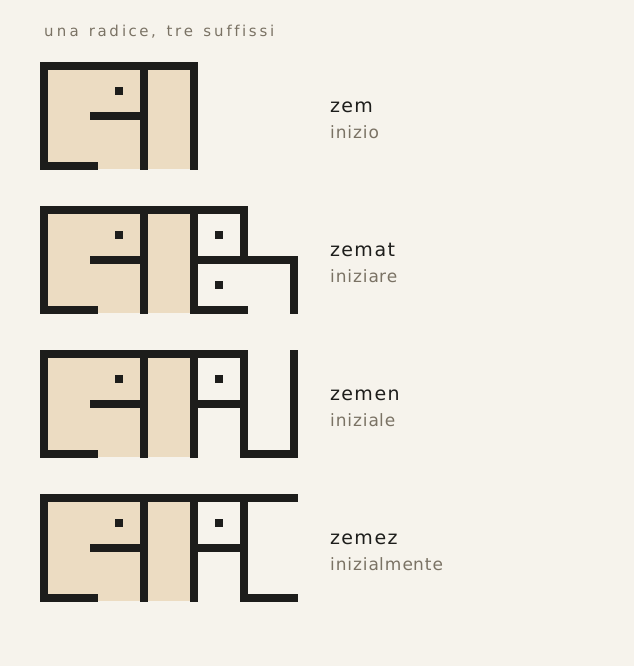
In the diagram the mechanism is visible at a glance: the three cells of the root stay fixed, and the suffix is added at the end.
Derivation is productive: from any root the four forms exist, whether they are recorded or not. The register lists only those that add a meaning of their own; gemes is the dog and gemesat is to bark, but no entry lists “to act with regard to the dog,” because the language forms it on its own and the word would say nothing new.
The noun and the sentence
The noun never changes form: it has no gender or plural. gemes means dog and dogs, sanup means girl and boy. The article is single and invariable, ne; the indefinite article is su. Number, when it matters, is expressed with a numeral; gender, when it matters, is expressed with a dedicated word.
The word order is subject, verb, complement. Determiners and adjectives precede the noun they refer to.
The verb
The verb has three tenses and no paradigm to learn:
| present | zemat — begins |
| past -ak | zematak — began |
| future -us | zematus — will begin |
Person is never marked on the verb: it is expressed by the pronoun, which for this reason cannot be omitted. Personal pronouns fall into two clean series, g- for the singular and z- for the plural: ga I, ge you, gu he/she, za we, ze you (pl.), zu they, guz oneself. Possessives are formed by adding -na: gana my, gena your, guna his/her, and so on.
Everything else is entrusted to seven invariable particles that stand before the verb and combine freely with one another:
| pe in progress | pu completed | te hypothetical | tu imperative |
| sa ability | se obligation | le passive |
The negation la opens the group and negates everything that follows.
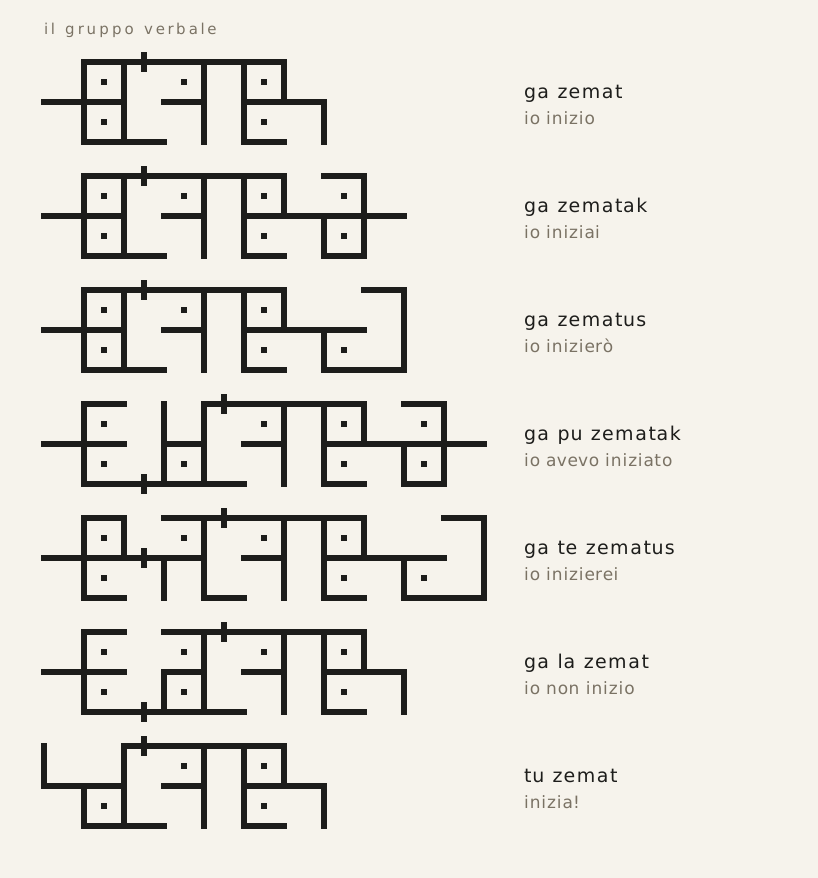
The verb group is assembled like a row of pieces: pronoun, particles, verb with its tense.
| ga zemat | I begin |
| ga la zemat | I do not begin |
| ga pe zemat | I am beginning |
| ga pu zematak | I had begun |
| ga te zematus | I would begin |
| ga se zemat | I must begin |
| tu zemat | begin! |
| le zemat | it is begun |
Function words
The minor word classes have a recognizable shape, and words admitted later follow it. The prepositions are almost all vowel plus consonant: a of, ut to, ez from, ek in, uz with, ar above, ub under, um between, ur toward, ap for, av without, an against, am beyond, ud until, ep during, ush through.
The conjunctions fall into families that alternate the vowel on the same consonant: va and, ve or, vu but, ven nor, vur despite; fe because, fu since, fa so that, fem indeed; ra while, re before, ru after, rem until.
The interrogatives are short and invariable: u what, which; mu who; ba what (thing); da where; de when; du why; ta how; tam how much. The particle dez corresponds to the English suffix -ever and is attached to an interrogative: mu dez whoever, da dez wherever.
The subordinate clause
The language has no relative pronouns: subordinate clauses open with the conjunctions listed above and are recognized, in writing, by the comma described in Punctuation. Direct speech is no exception — it is a subordinate clause governed by the verb of saying, alnerat — and has no marks of its own.
Set phrases
Two expressions are not translated word for word and must be learned as they are:
| u zebu gum | what time is it? |
| zebu a zemat | time to begin |
The hour count referred to in the first phrase follows the Solarian calendar and the base-7 numeral system.