
The symbolic meridians are seven lines crossing Solaria, connecting its capitals. They arise from the need to give a symbolic form to the island, translating a musical object — the circle of fifths — into a geography that can be traveled through a narrative.
In a time when Solaria is crossed by a deep fracture, between North and South, between concept and object, the meridians represent lines of connection: they imply the idea of a complete and tuned world, in which opposites are not eliminated, but held together, recognized and harmonized.
To trace them means to affirm that the meaning of existence is a movement that, from its origin, passes through the seven elements — space, time, matter, energy, light, information and consciousness — reaches fulfillment in art, and finally returns to the initial unity, to the point where the journey began. Every line drawn is therefore an attempt to recompose what has been broken.
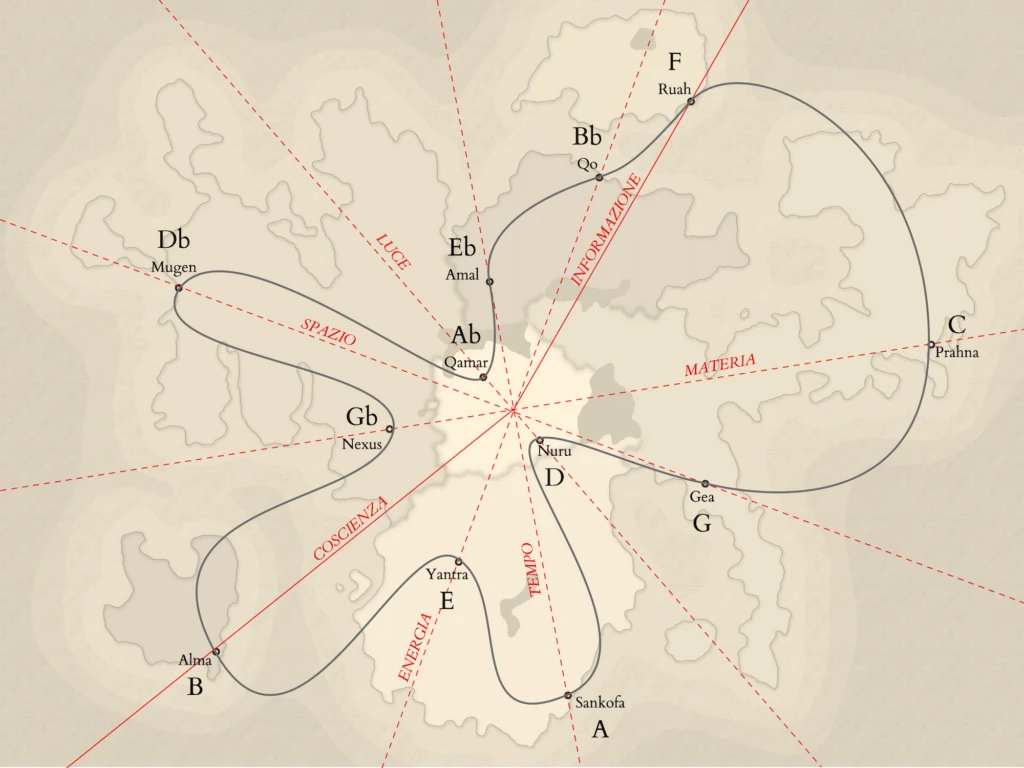
The seven meridians of Solaria. Each red line joins two opposite capitals, at a distance of a tritone; the dark line is the circle of fifths.
The harmony of opposites
Each of the five natural meridians casts a bridge between two opposite and complementary cities: it unites nations that war would like to be enemies, forcing them to recognize themselves as parts of a single deep structure, like the two poles of a single element.
In musical symbolism this bond corresponds to an interval of tritone: the only interval that, when inverted, remains unchanged, and which for this reason represents the identity and harmony of opposites.
Each meridian thus reminds us that no portion of truth can be called complete unless it accepts to mirror itself in its own opposite: what the North grasps as clarity and abstraction finds fulfillment only in the South, in the density of experience and matter.
The five natural meridians
| Meridian | Southern capital | Northern capital | Interval |
|---|---|---|---|
| Space | Gea (G) | Mugen (D♭) | tritone |
| Matter | Prahna (C) | Nexus (G♭) | tritone |
| Energy | Yantra (E) | Qo (B♭) | tritone |
| Time | Sankofa (A) | Amal (E♭) | tritone |
| Light | Nuru (D) | Qamar (A♭) | tritone |
The meridian of space
The first bond is an arc stretched between the infinity of Mugen — the city where the infinity of possibilities and the dynamics emerging from non-linear systems are studied — and the singularity of Gea, where reality is understood starting from the particular, from the single living being, unique and unrepeatable though belonging to a wider order.
It is an axis that breathes between the immensely large and the immensely small, almost suggesting that the cosmos is nothing but the magnified reflection of a cell.
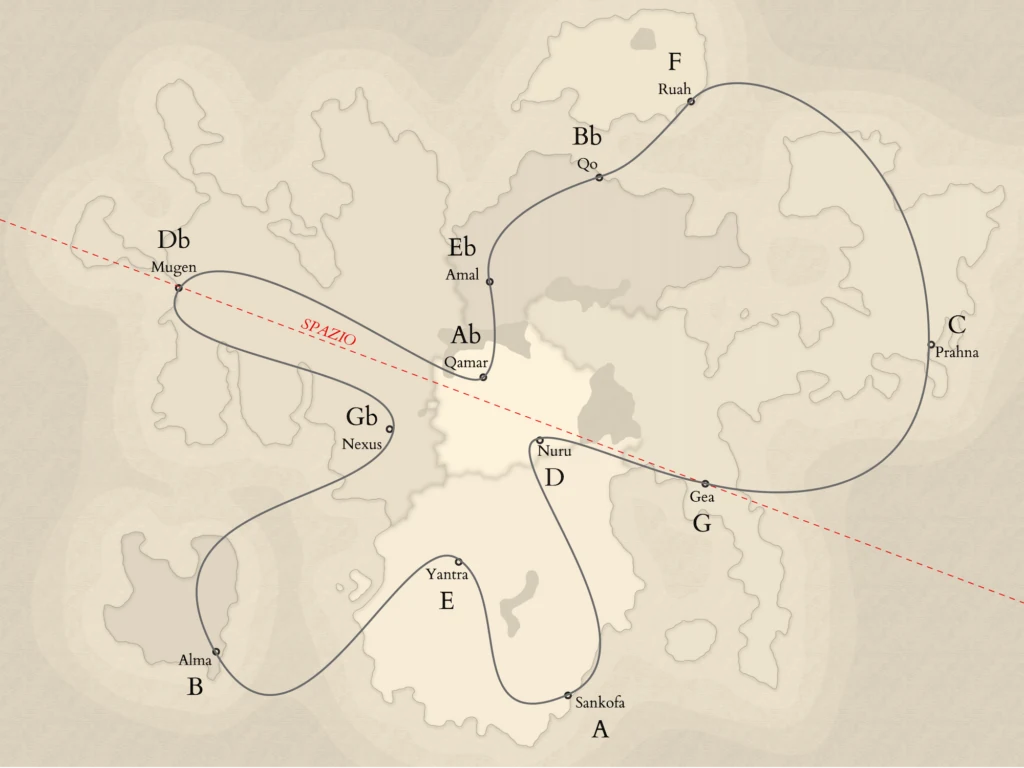
The meridian of space, from Gea to Mugen.
The meridian of matter
Alongside runs the meridian of matter, expressed in its two fundamental instances: form and essence. On one side the rigor of Nexus, where science attempts to harness the infinite into intelligible structures; on the other the vital breath of Prahna, the invisible principle that animates every creature.
On this axis mathematical form and living essence recognize themselves as inseparable: without a structure the universe is chaos, but without the vital breath it is only an inert shell.
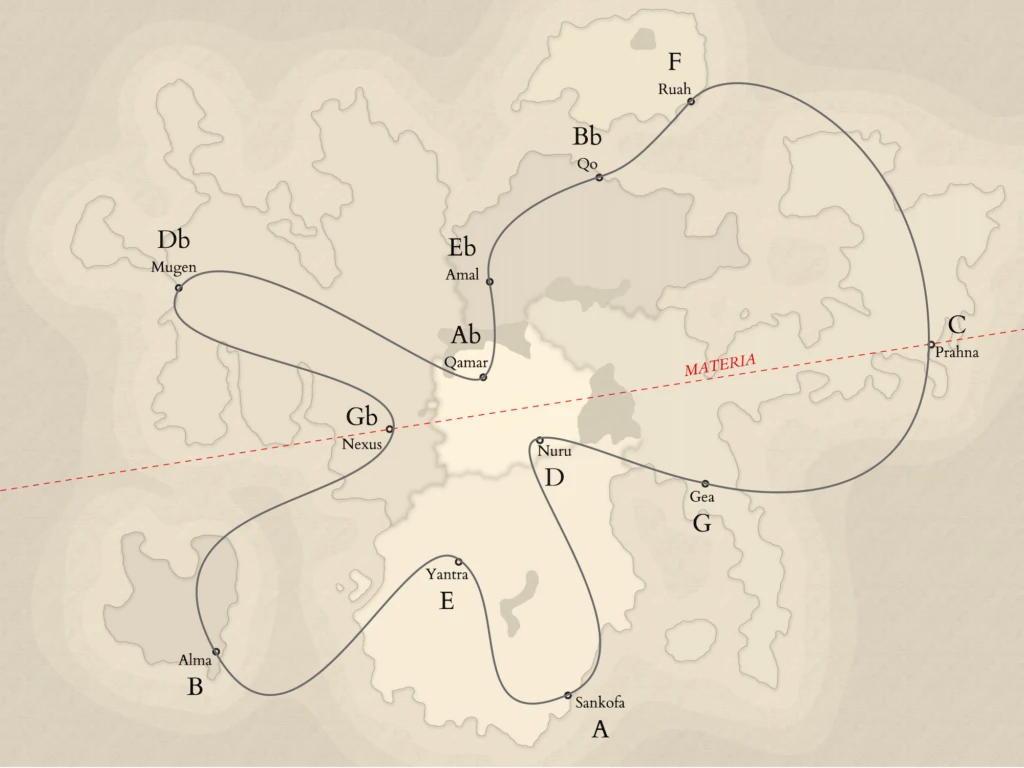
The meridian of matter, from Prahna to Nexus.
The meridian of energy
The meridian of energy unites Yantra to Qo, tracing the passage from the power of energy in act — embodied by the machine, industry and action — to the resonance of potential energy, made of relation, empathy and communication. Qo is in fact the place of energy that has not yet manifested, but which orients future movement and action.
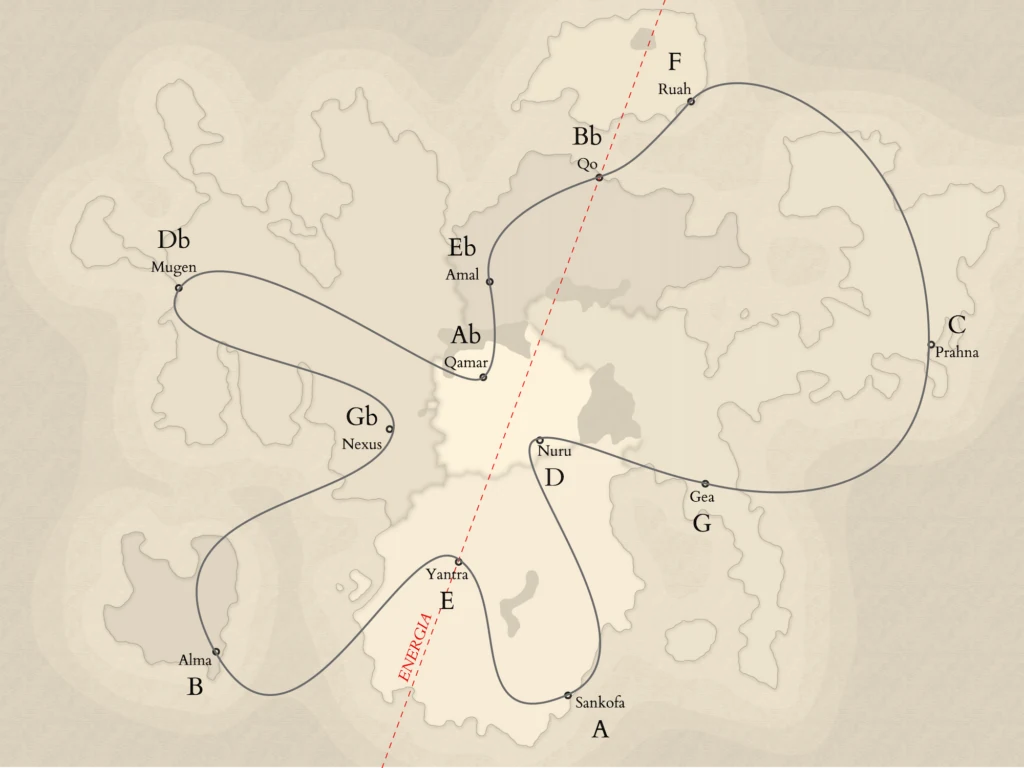
The meridian of energy, from Yantra to Qo.
The meridian of time
The meridian of time connects the technical memory of Sankofa to the pedagogical vision of Amal. The dialogue between past and future affirms that there is no push toward tomorrow that does not first pass through the recognition of the value of experience, a necessary condition for imagining and becoming what we will be.
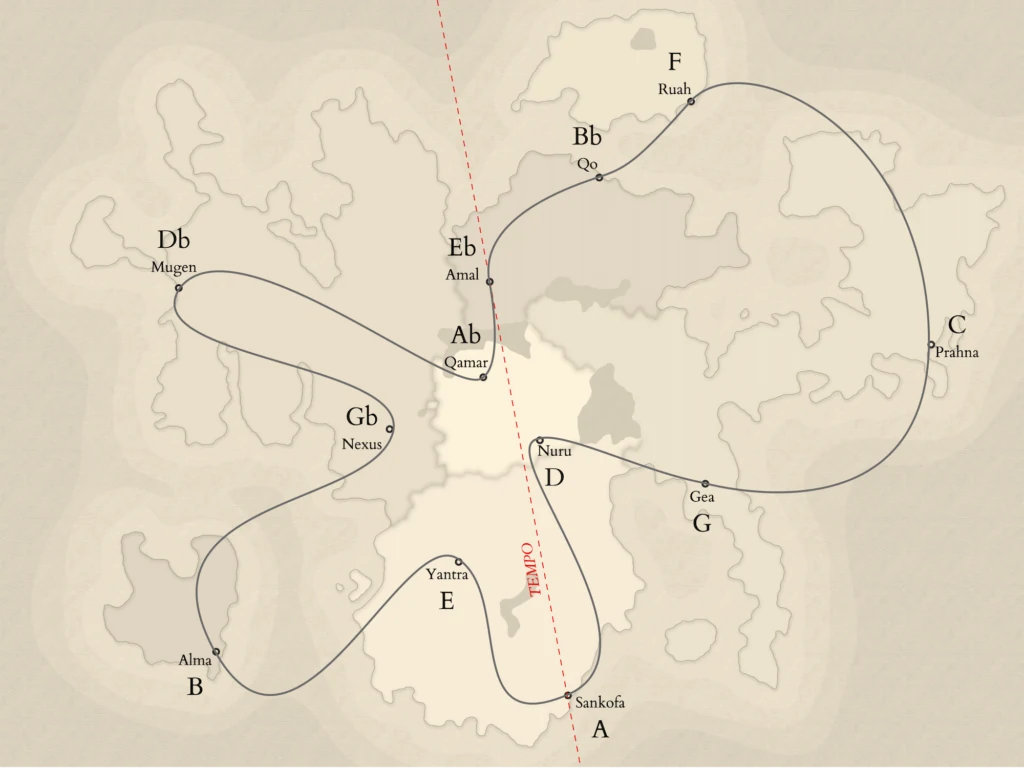
The meridian of time, from Sankofa to Amal.
The meridian of light
The axis of light connects the radiant light of Nuru to the reflected light of Qamar. Light is the quintessence, the principle that holds together space and time, mass and energy. If in Nuru the divine, or philosophical truth, becomes creative action in the world, in Qamar it opens to contemplation and reflection.
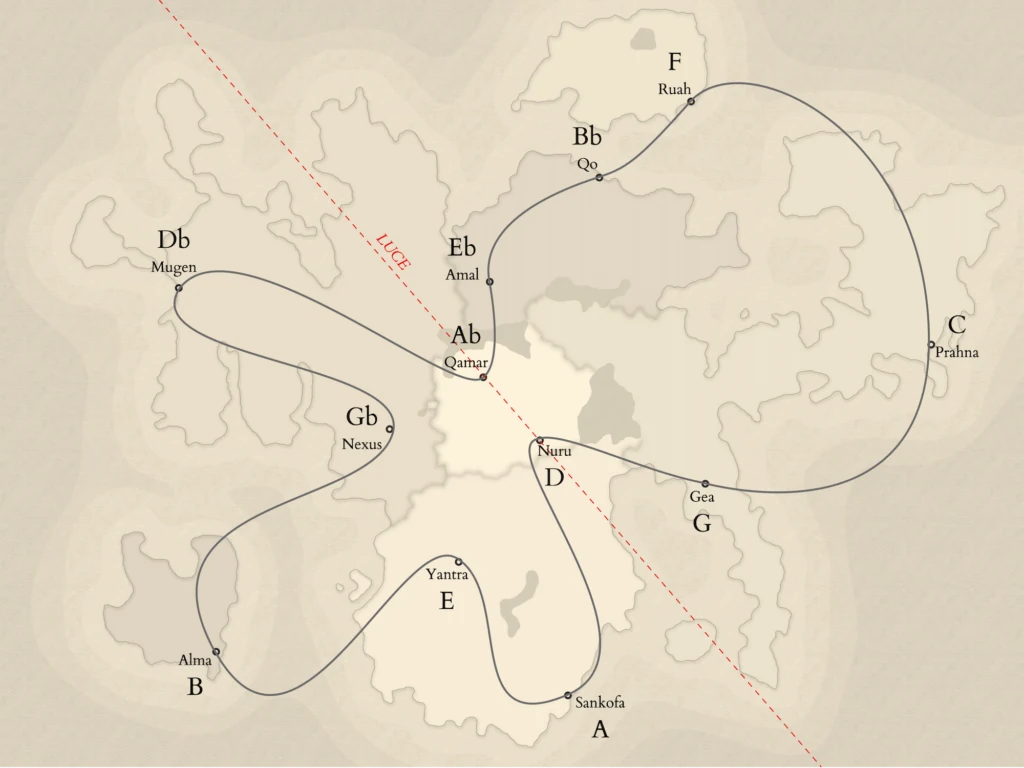
The meridian of light, from Nuru to Qamar.
The spiritual refraction
All the meridians meet at the center of the island, at Altaluna. This is no coincidence: Altaluna is the territory that receives the light of the sun and returns it as reflected light.
In Altaluna the original light is not yet separated into its own opposites. The plateau functions as a prism: light, passing through it, no longer proceeds in a straight line, but bends, inclines and differentiates. It does not break, it translates; and it is in this deviation that human experience as such is born.
Thus, alongside the meridians that describe the relationship between man and the elements of the world, two others emerge, which describe human experience in itself: they derive from a single meridian that, in Altaluna, inclines and refracts.
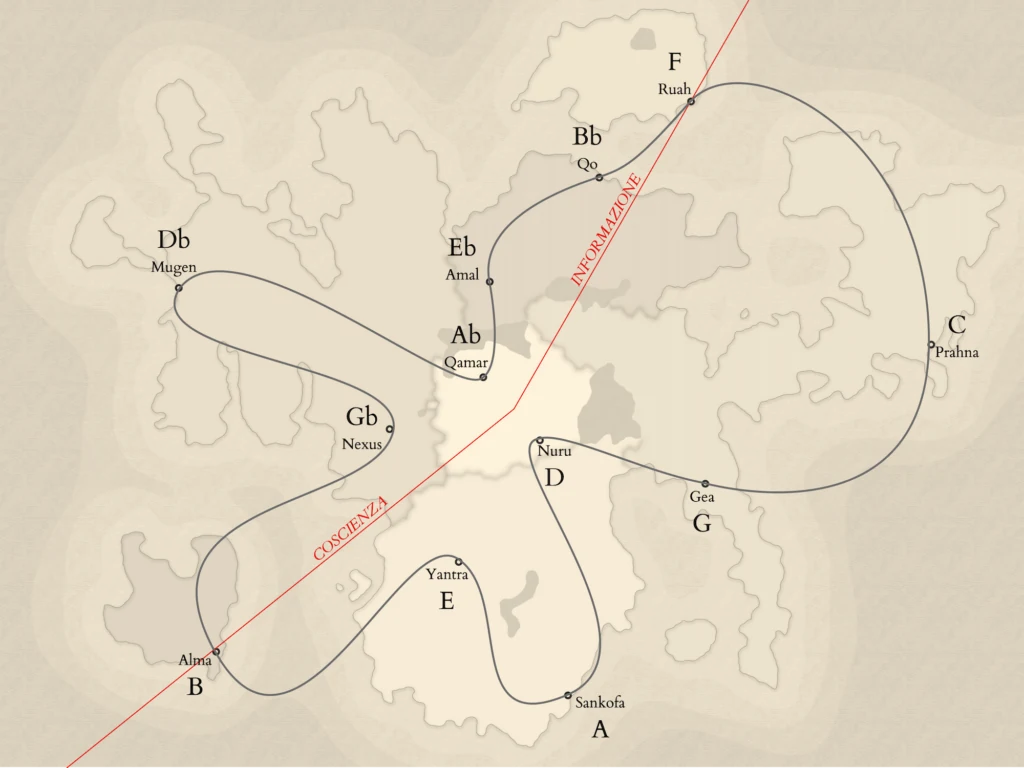
The two meridians of human experience: consciousness passes through Alma, information through Ruah, on the same line that cuts across the island.
The two meridians of human experience
The meridian of consciousness
The first is the meridian of consciousness and the soul, the one concerning human nature in its immaterial dimension. It passes through the city of Alma (B) and questions the human being not for what they do or build, but for what they are. Along this axis lie the questions about identity, about the origin of consciousness, about the relationship between subject and world, between interiority and experience.
It is the point where the human being recognizes themselves as a subject, as a center of experience, and takes note of the mystery that constitutes them.
The meridian of information
The second is the meridian of information and the message, the one in which nature and matter present themselves to man as a question. It passes through Ruah (F) and concerns what comes to meet the subject from the outside: phenomena, the structures of the world, data, signs, everything that asks to be interpreted, understood, translated into knowledge.
The two meridians are complementary: if the first concerns the one who observes, the second concerns what is observed; one arises from within, the other comes from without. It is at their crossing that human experience takes shape, as a continuous dialogue between a world that offers itself as information and a consciousness called to transform it into meaning. Even the two notes that represent them, B and F, form a tritone: the same one that in the chromatic total remains excluded from the two warring pentatonics.
This is also the meridian of art. From the refraction of consciousness in the world, artistic experience is in fact born: not as an ultimate end, but as a provisional synthesis in which all the elements converge. Art is the place of harmony between light, consciousness and matter.
The return to the soul
The movement is not unidirectional. If from consciousness light reaches art by passing through experience and spiritual refraction, from art the reverse path is also possible: the work, when it does not close in on itself, returns to being a question. By passing through it, one can climb back from message to meaning, from meaning to soul, from soul to consciousness, up to questioning the light that generated it.
Related entries
Seven Elements
Light
Symbolic Geography
Tritone
Chromatic Total and the Cycle of Fifths
The Twelve Capitals
The Seven Nations