
In kudamaf writing, the line is a unit of measure before it is a typographic convention: every line has the same number of cells, without exception. A Kudamef text, opened to any page, presents itself as an exact grid of overlapping ribbons, all of the same length.
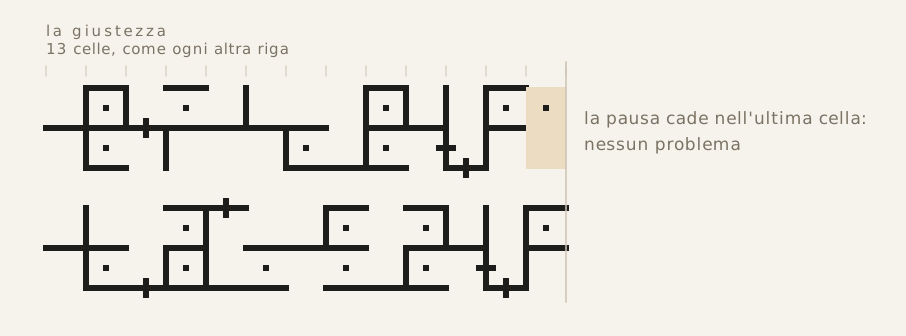
Lines of equal justification. The pause falls in the last cell and creates no problem whatsoever.
The reasons given are three, and they are the same ones heard in workshops regarding any manufactured object: compactness, because no slab or ink is wasted; solidity, because a line of fixed measure is engraved on standard supports and can be replaced without redoing the page; legibility, because the position of each cell is calculated rather than searched for.
Line breaks happen anywhere
If the justification is rigid, the text must bend. And indeed a line break happens anywhere, even in the middle of a word, even between two letters that in speech are never separated. Pazan knows no syllabification: the word is a continuous stroke and the line break cuts it wherever it happens to fall.
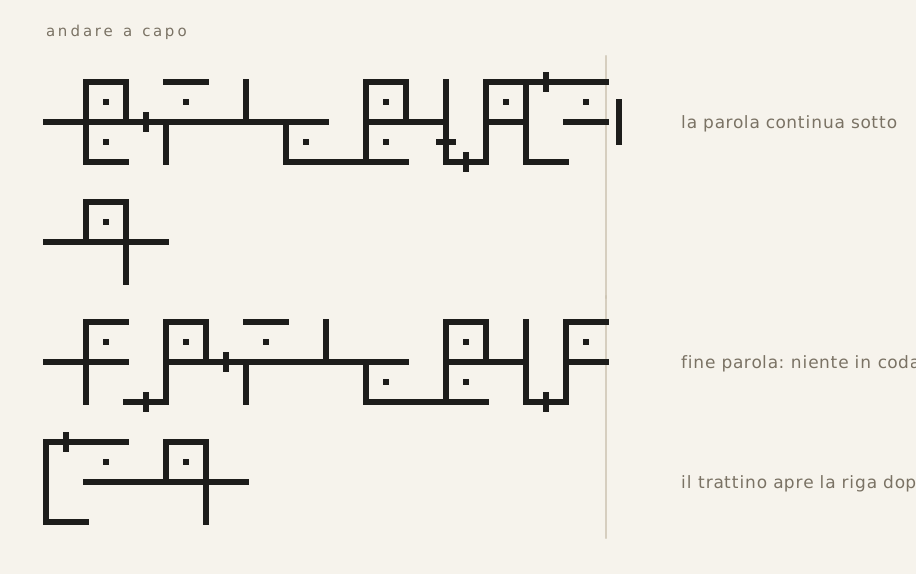
Above: the word continues on the following line. Below: the line ends at the end of a word.
So that the cut is not confused with the end of a word, the margin carries a mark:
| the word continues below | a vertical stroke in the right margin, centered on the median, as long as a cell line |
| the line ends at the end of a word | nothing at the tail: the following line opens with the normal word-start dash |
The margin stroke sits outside the ribbon, set apart from the edge by exactly the distance at which the fourth line runs: it is the same measure as the comma and the digit dash, turned onto the side of the line. Readers recognize it without having to learn it, because it is a measure the system already uses elsewhere.
The pause, being a cell like any other, can fall in any position, including the last one in the line: no rule moves it and no line is lengthened to accommodate it.
The line spacing
Between the band of one line and that of the following line runs a half-cell of white space. The line pitch thus comes out to three half-cells: two for the band of letters, one for the gap.
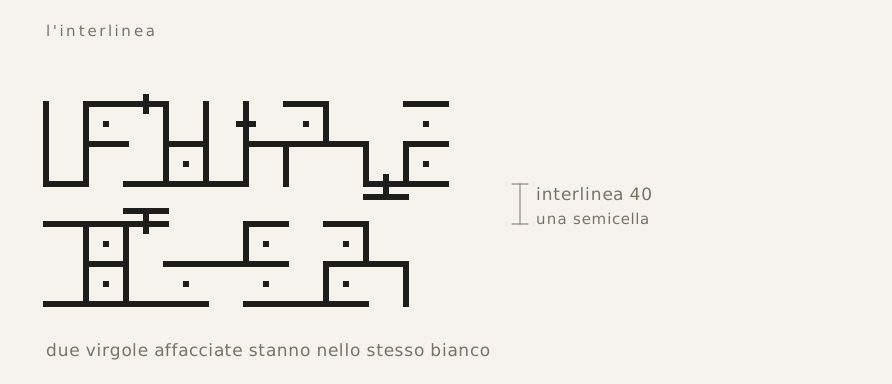
The line pitch. In the white space between two ribbons there is also room for two facing commas.
The measure is calibrated for the worst case. In the white space two marks can face each other, the low comma of the upper line and the high comma of the lower line, which together occupy just over three quarters of the available space: a visible margin remains and there is no overlap. A tighter line spacing would make them touch, and two fused marks would say something that does not exist in the writing system.
A closed system
With the rule of the line, pazan is considered complete: eighteen letters, four pauses, a comma, a paragraph mark, and seven digits. Nothing more is meant to be added to it, and in Kudamef this is the highest compliment one can pay to a manufactured object.