
Lydian and Locrian in the circle of fifths
The relationship between Lydian and Locrian can be read as a natural consequence of the circle of fifths. If the modes are arranged along this circle, they no longer appear as isolated structures, but as points in a single movement: from a maximum openness toward ascending fifths to a maximum closure toward descending fifths. In this space, Lydian and Locrian occupy the two extreme poles of the system.
Diatonic modes ordered on the circle of fifths
The seven diatonic modes can be ordered along the circle of fifths from brightest to darkest. Taking C as the reference note, the order is as follows:
| Mode | Notes | Tones and semitones | Variation |
|---|---|---|---|
| C Lydian | C - D - E - F# - G - A - B | T - T - T - S - T - T - S | — |
| C Ionian | C - D - E - F - G - A - B | T - T - S - T - T - T - S | F# → F |
| C Mixolydian | C - D - E - F - G - A - Bb | T - T - S - T - T - S - T | B → Bb |
| C Dorian | C - D - Eb - F - G - A - Bb | T - S - T - T - T - S - T | E → Eb |
| C Aeolian | C - D - Eb - F - G - Ab - Bb | T - S - T - T - S - T - T | A → Ab |
| C Phrygian | C - Db - Eb - F - G - Ab - Bb | S - T - T - T - S - T - T | D → Db |
| C Locrian | C - Db - Eb - F - Gb - Ab - Bb | S - T - T - S - T - T - T | G → Gb |
In this sequence each mode arises from the previous one by lowering a single note by a semitone. The passage from the brightest mode to the darkest mode thus occurs by degrees: F#, B, E, A, D and G are progressively lowered, following the order of the circle of fifths.
| Mode | Position in the modal series | Interval formula | Character |
|---|---|---|---|
| C Lydian | Bright extreme | 1 - 2 - 3 - #4 - 5 - 6 - 7 | Maximum openness |
| C Locrian | Dark extreme | 1 - b2 - b3 - 4 - b5 - b6 - b7 | Maximum closure |
Lydian and Locrian occupy the two extremes of the modal series. Lydian is the most open mode because it contains, relative to the tonic, a major second, major third, augmented fourth, perfect fifth, major sixth and major seventh. Locrian, on the other hand, is the most closed mode because it contains a minor second, minor third, perfect fourth, diminished fifth, minor sixth and minor seventh.
Ambivalence of the tritone
| Mode | Characteristic note | Interval formula | Reading of the tritone |
|---|---|---|---|
| C Lydian | F# | #4 | Tritone as augmented fourth |
| C Locrian | Gb | b5 | Tritone as diminished fifth |
The distance between C and F#/Gb is the same from an acoustic point of view: a tritone. In C Lydian it is written as #4, that is augmented fourth, because it derives from raising the fourth. In C Locrian it is written as b5, that is diminished fifth, because it derives from lowering the fifth. The tritone is therefore the same acoustic interval, but takes on two names and two different theoretical functions depending on the modal context.
Opposition and contiguity
The apparent opposition between Lydian and Locrian, however, can be overcome with a minimal shift of the tonal center.
After traversing the entire modal sequence on the same tonic, from C Lydian to C Locrian, six notes out of seven have been lowered. The only note that remains unchanged is the modal tonic, that is C. At that point, by also lowering the fundamental by a semitone, the system does not simply close: it starts over a semitone lower.
| Mode | Notes | Tones and semitones | Variation |
|---|---|---|---|
| C Locrian | C - Db - Eb - F - Gb - Ab - Bb | S - T - T - S - T - T - T | — |
| B Lydian | B - Db - Eb - F - Gb - Ab - Bb | T - T - T - S - T - T - S | C → B |
Starting from C Locrian, the darkest form of the modal system built on C, all that remains is to lower the fundamental note. If C descends to B, while all the other notes remain identical, the scale becomes B Lydian. In enharmonic notation, B - Db - Eb - F - Gb - Ab - Bb corresponds to B - C# - D# - E# - F# - G# - A#, that is B Lydian. The passage from Locrian to Lydian thus occurs through the lowering of only the modal tonic: after exhausting the cycle of alterations on the same fundamental, the system begins again with an analogous sequence, but transposed a semitone lower.
For this reason, Lydian and Locrian are at the same time the opposite extremes of the modal cycle and two contiguous forms: they are very distant when observed as modes on the same tonic, but they become immediately communicating if the tonal center is shifted by a single semitone downward.
The system thus shows a double structure. On one hand, ordering the modes on the same tonic, the passage from Lydian to Locrian occurs through a progressive darkening of the scale, note after note, semitone after semitone. On the other hand, Lydian can transform directly into Locrian without modifying the sound material, simply by lowering the fundamental and reassigning a new tonal function to the same seven notes.
Opposite halves in the circle of fifths
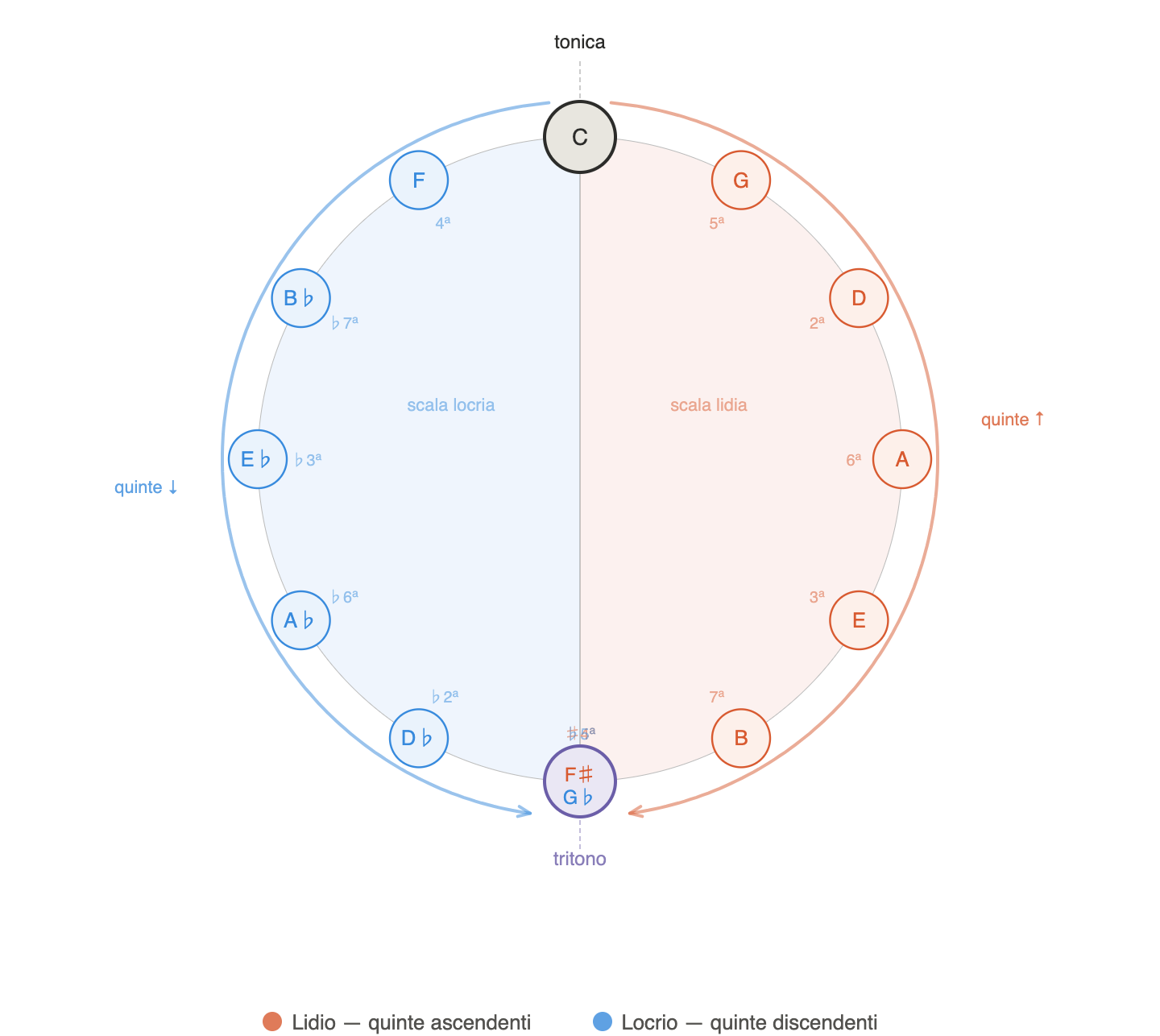
If one takes a note as center, for example C, and ideally places it at noon in the circle of fifths, Lydian represents the maximum expansion to the right, that is toward the ascending fifths:
C - G - D - A - E - B - F#
Rearranged in scalar form, these notes produce C Lydian:
C - D - E - F# - G - A - B
Locrian, on the other hand, represents the maximum expansion to the left, that is toward the descending fifths:
C - F - Bb - Eb - Ab - Db - Gb
Rearranged in scalar form, these notes produce C Locrian:
C - Db - Eb - F - Gb - Ab - Bb
Lydian is thus the most “rightward” mode of the circle of fifths, while Locrian is the most “leftward”. The former concentrates major or augmented intervals; the latter concentrates minor or diminished intervals.
Spiral form
The relationship between Lydian and Locrian can also be imagined as a double spiral built around the origin of a Cartesian system. The tonic is located at point 0; from there the spiral proceeds by semitones, alternating movement below and above the center. At each semicircle the radius increases by 1, that is by one semitone.
The formula of the spiral is r = n, θ = nπ, where n indicates the progressive number of the semicircle. Every time θ increases by π, the spiral completes a half turn and the radius grows by one unit. The intersections with the x-axis thus produce a sequence of alternating chromatic distances relative to the tonic.
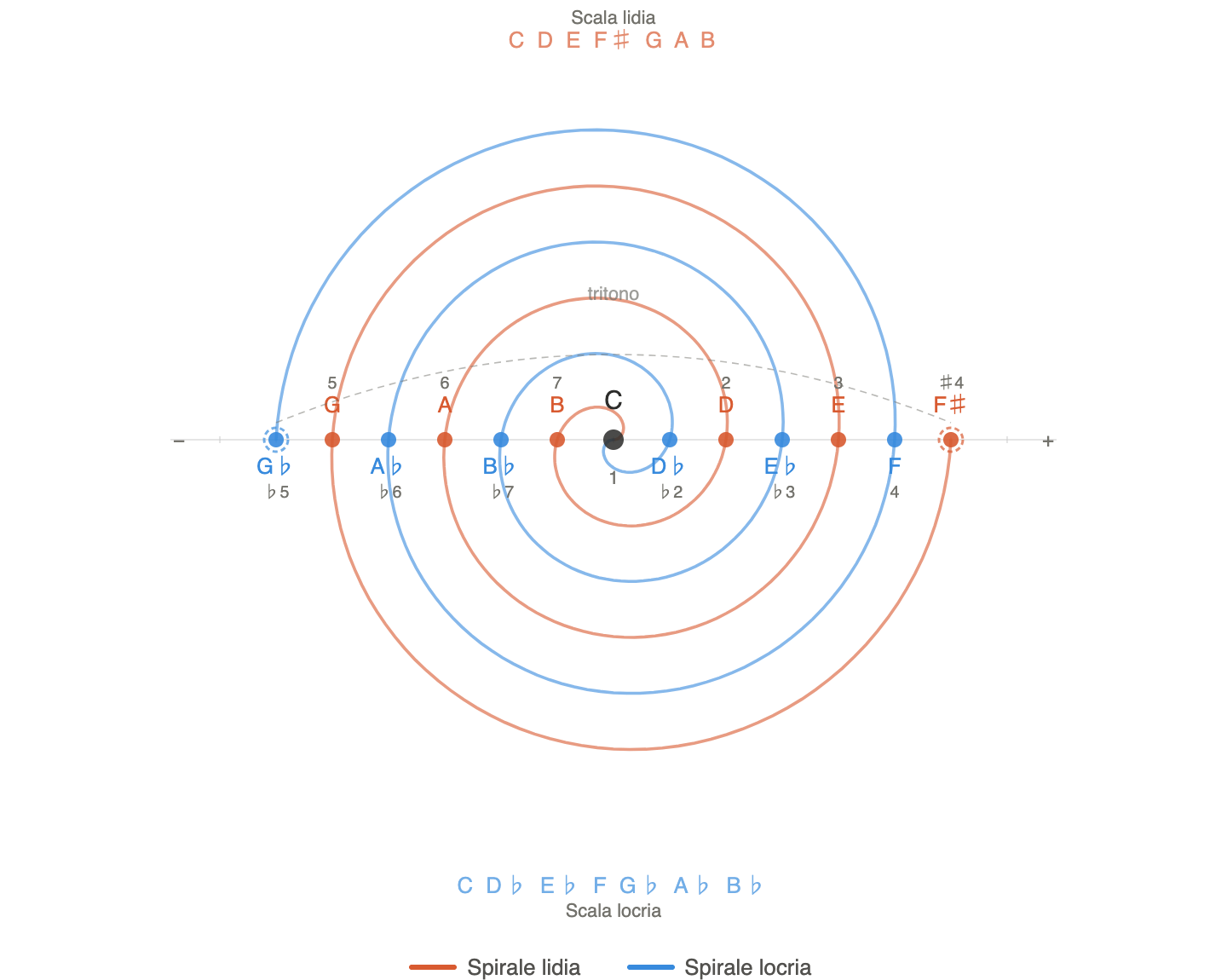
Table 1 — Lydian spiral
| x-axis | Displacement in semitones from C | Note obtained | Interval function in the scale |
|---|---|---|---|
| 0 | 0 | C | 1 |
| -1 | 1 semitone below | B | 7 |
| +2 | 2 semitones above | D | 2 |
| -3 | 3 semitones below | A | 6 |
| +4 | 4 semitones above | E | 3 |
| -5 | 5 semitones below | G | 5 |
| +6 | 6 semitones above | F# | #4 |
Table 2 — Locrian spiral
| x-axis | Displacement in semitones from C | Note obtained | Interval function in the scale |
|---|---|---|---|
| 0 | 0 | C | 1 |
| +1 | 1 semitone above | Db | b2 |
| -2 | 2 semitones below | Bb | b7 |
| +3 | 3 semitones above | Eb | b3 |
| -4 | 4 semitones below | Ab | b6 |
| +5 | 5 semitones above | F | 4 |
| -6 | 6 semitones below | Gb | b5 |
The two spirals are therefore mirror images of each other. Lydian organizes the intervals in the direction of maximum openness: 2, 3, #4, 5, 6, 7. Locrian reverses the rotation and organizes the intervals in the direction of maximum closure: b2, b3, 4, b5, b6, b7.
The extreme point of both spirals is the tritone. In Lydian it is reached as +6 semitones, that is #4; in Locrian it is reached as -6 semitones, that is b5. From a graphic point of view it is thus possible to connect a Lydian scale to a Locrian scale by reversing the rotation of the spiral once the tritone is reached. The tritone thus becomes, together with the origin, the welding point between the two orientations: on one side it closes the Lydian spiral, on the other it opens the Locrian spiral in the opposite direction.
Polymodal tonality
In the traditional sense, the leading tone is a note placed a semitone below the arrival note that tends to resolve upward: for example B tends toward C. The same principle, however, can also be thought of in reverse: a note placed a semitone above the arrival note can resolve downward, as Db tends toward C. In this way two types of attraction can be distinguished: a lower leading tone, which rises toward its resolution, and an upper leading tone, which descends.
The Lydian mode can be read as an ascending scale on the tonic because it contains two lower leading tones:
| Scale | Notes | Lower leading tones | Resolution |
|---|---|---|---|
| C Lydian | C - D - E - F# - G - A - B | B, F# | B → C, F# → G |
| Function | 1 - 2 - 3 - #4 - 5 - 6 - 7 | 7, #4 | 7 → 1, #4 → 5 |
The note B is a semitone below C and tends to resolve toward the tonic; the note F# is a semitone below G and tends to resolve toward the fifth. Lydian thus contains two ascending drives: B → C and F# → G. For this reason it can be interpreted as a field that rises toward the two main poles of the tonic: 1 and 5. Lydian is therefore an ascending scale.
Locrian works in a mirror-like way. It does not contain a perfect fifth, but a diminished fifth; for this reason its descending attractions are not oriented toward 1 and 5, but toward 1 and 4:
| Scale | Notes | Upper leading tones | Resolution |
|---|---|---|---|
| C Locrian | C - Db - Eb - F - Gb - Ab - Bb | Db, Gb | Db → C, Gb → F |
| Function | 1 - b2 - b3 - 4 - b5 - b6 - b7 | b2, b5 | b2 → 1, b5 → 4 |
The note Db is a semitone above C and tends to resolve toward the tonic; the note Gb is a semitone above F and tends to resolve toward the fourth. Locrian thus contains two descending drives, Db → C and Gb → F, and for this reason it is a descending scale.
At this point, keeping C and G as poles of resolution, the Lydian mode and the Locrian mode can be read as two opposite ways of approaching these same points:
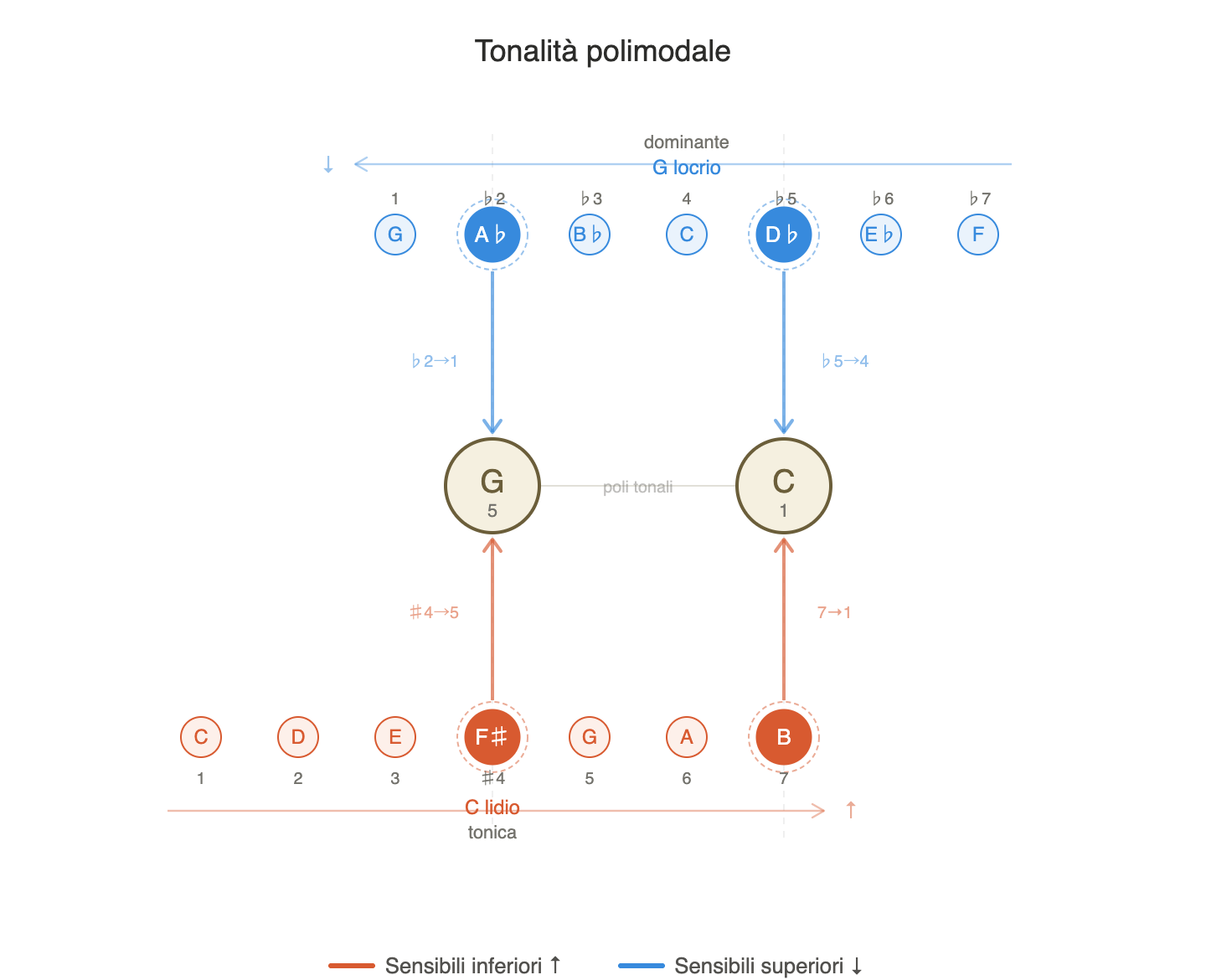
Thus C Lydian and G Locrian both converge on C and G, but from opposite directions. C Lydian tends toward C and G from below; G Locrian tends toward G and C from above. The former organizes an ascending tension on the tonic root-fifth dyad, the latter a descending tension on the dominant. In this sense Lydian rises toward the tonal poles, while Locrian descends toward the same poles.
These two movements embody the movement and tension/resolution between tonic and dominant, extending the framework of tonal music to the twelve sounds of the chromatic scale. For this reason this framework can be defined as ‘polymodal tonality’.
Harmonic series
The root of the Lydian-Locrian system can be formulated as a generative hypothesis starting from the harmonic series. In this reading, it is not a matter of directly deriving a scale from the harmonic series, but of observing certain significant features found between tonic and dominant, and between dominant and return to tonic. From these features interval cells are extracted which, when repeated, generate respectively the Lydian field and the Locrian field.