
Symbolic geography is the constructive principle on which Solaria is founded. The island is not a narrative backdrop, but a map in which political borders coincide with lines of meaning: each region represents a different way of thinking and inhabiting the world, each capital corresponds to a note, and each relationship between territories to a musical interval.
Understood in this way, symbolic geography is at once a cognitive model, since it traces territories in which the relationships between the different spheres of human experience are arranged, and a generative tool, since from those relationships the forms of narrative and composition are born. Solaria is therefore the island of knowledge and human activity, described simultaneously on three planes: symbolic, mathematical, and musical.
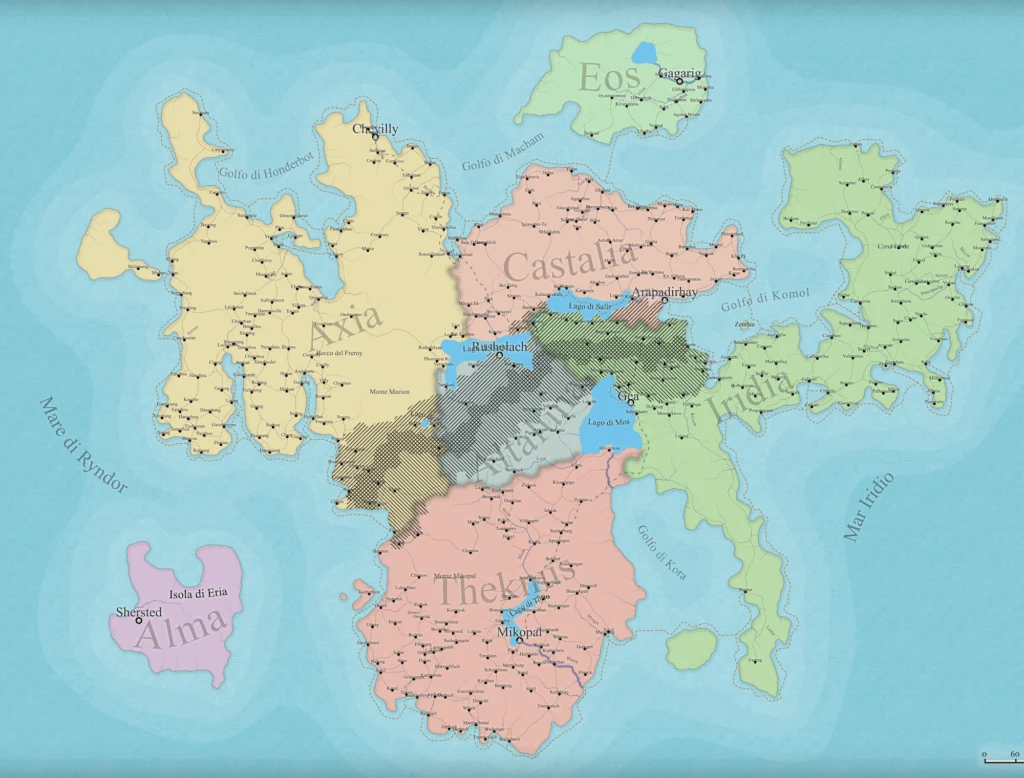
Solaria: the five continental regions, the two minor islands, and, dashed in the center, the line of the front.
The seven territories
The island is divided into seven regions: five central fields of human activity — nature, technology, science, communication, and philosophy and religion — and two minor islands, which represent consciousness and art.
The number seven does not arise from an aesthetic choice, but from the need to condense all areas of knowledge into a coherent system. The spheres of human activity are infinite, and the regions of Solaria could have been countless, as happens in academic taxonomies; the reduction to seven occurs through condensation, selecting the areas that act as matrices for all the others.
The fields not named do not disappear: economics, medicine, ecology, pedagogy, psychology, history, and politics are traced back to the five central regions according to their epistemological origin, that is, to the question from which they arise and the form of knowledge they embody. Each territory thus contains within itself numerous other fields of knowledge.
The five questions
Each central territory corresponds to a fundamental question.
| Region | Domain | Question |
|---|---|---|
| Iridia | nature | where |
| Theknus | technology | how |
| Axia | science | the why of things |
| Castalia | communication | who |
| Altaluna | philosophy and religion | the why of man |
The minor islands
The two minor islands are distinguished from the central regions because they do not represent a field of knowledge, but the path of human experience, understood as a traversal of the five main territories. This path has two poles: Alma, consciousness, and Eos, which is at once information and art, that is, the synthesis of all the regions of the continent.
Alma and Eos form the two poles of a single orbit: consciousness finds its answer in artistic experience, and art, in turn, leads consciousness back to its own origin. This is why the two islands lie at opposite ends of the central regions, geographically separated from the continent.
A circular geography
The map of Solaria translates the circle of fifths, the musical object that makes possible the coexistence of the twelve notes without absolute hierarchies. Solaria is its symbolic equivalent: a map in which every point is necessary to the others and none can be isolated without losing meaning.
It is therefore not a progressive line, in which meaning would consist in reaching a destination, but a circular geography, in which meaning arises from rotating, from returning, and from connecting points that belong to the same form: points already close to one another, even when they appear opposite.
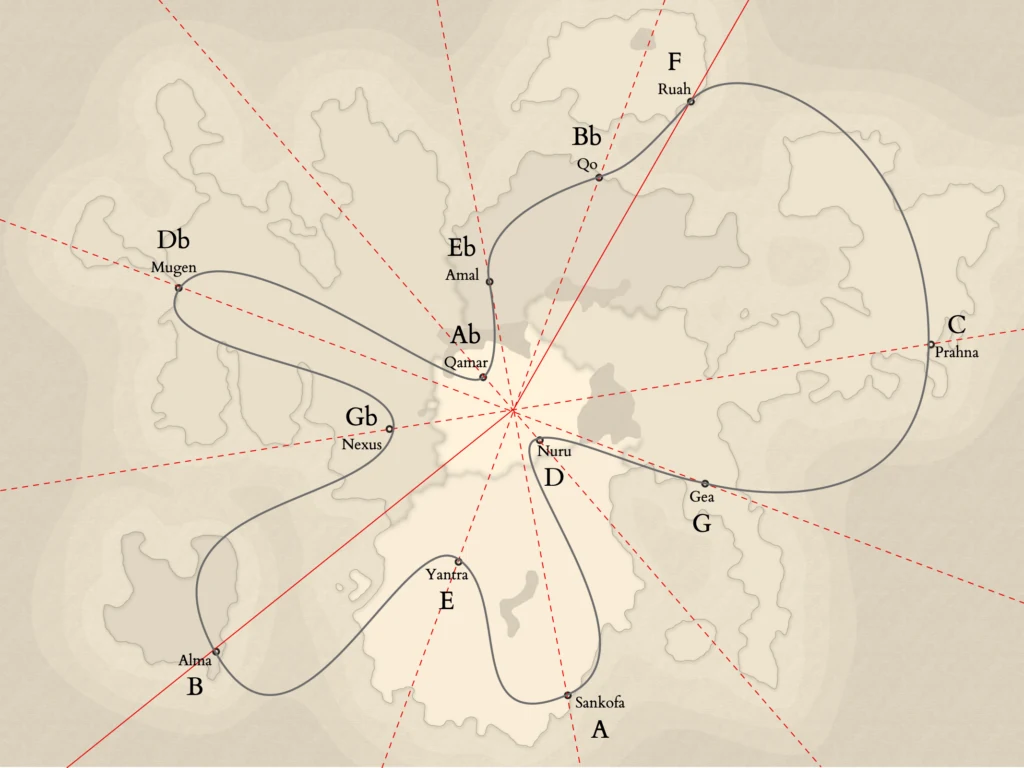
The circle of fifths traced onto the twelve capitals: the solid line connects them by fifths, the red lines are the seven meridians.
The correspondences
The symbolic geography of Solaria is structured on four levels, coherent with one another.
| Geographic level | Symbolic correspondence |
|---|---|
| The seven territories | the seven elements |
| The twelve capitals | the twelve notes of the chromatic total |
| The seven meridians | the intervals of tritone joining the opposites |
| The two coalitions | the two complementary pentatonic scales |
Related entries
Seven Elements
Symbolic Meridians
Light
The Seven Nations
The Twelve Capitals
Chromatic Total and the Cycle of Fifths
Exonyms and Endonyms