
Kudamaf is the language of the nation of Kudamef, which occupies the southern part of the island of Solaria. The two names come from the same root, kudam, technical: -ef indicates territory, -af language, itself derived from afar, language. Earthly sources instead use the exonyms Theknus and Theknusian; for the distinction between the two levels of naming, see Exonyms and Endonyms.
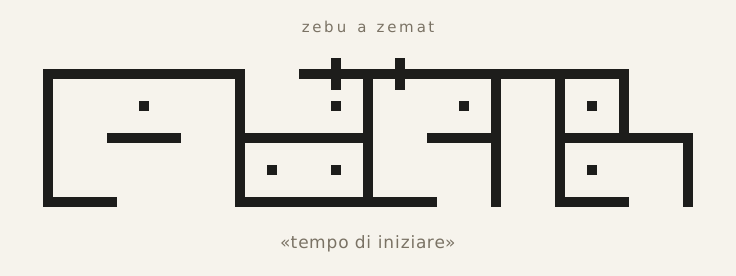
The inscription on the architrave of the Forum of Technical Arts of Kena
In Kudamef a language is considered an artifact, and of an artifact one asks the same things one asks of a machine: that it work the same way every time, that it can be taken apart, and that it have no useless parts. From this everything else follows: only three vowels, few elements, no irregular verbs, a solid and continuous graphic structure.
Note
The complete lexicon, a translator from Italian, and a viewer that displays any text in Kudamaf can be found in the language application.
History
The Language of the Workshops
The oldest forms of Kudamaf belong to the settlements that arose along the Rasha River, when the basin at the foot of Mount Uruk was not yet a city but a succession of mills, wheels, and forges. From that phase mainly short, concrete roots survive, tied to work and matter: rash, the force that passes through something and changes it; ken, the machine; uklan, an archaic variant of kudam, from which comes the ancient name of the country, Uklanef.
It was a spoken, not written, language, and in indirect attestations it appears far less regular than it is today: it had irregular forms, a plural, traces of agreement (grammatical correspondence of gender, number, person, or case between related words). None of what characterizes Kudamaf today was yet in place.
From Drawing to Writing
The writing system was not born of literary need but from the drafting table. In the workshops of the Rasha, measurements and instructions were noted along a band ruled with three lines, the same one used to trace profiles: a high line, a middle line, a low line. The words written on that band took the shape of the objects drawn beside them — straight segments, vertical strokes, no curves — and inherited their continuity from them.
It is to this origin that the inventory of sounds is traced back. For instance, in the cell the point has three possible states — high, low, both — and there are exactly three vowels. Whether it was the writing that reduced the vowels or the vowels that suggested the point is a question debated for centuries; in Kudamef the answer given, with a certain satisfaction, is that the question makes no sense, because language and writing are the same object seen from two sides.
The Norm
When Kena became the technical center of the island and the Forum of Technical Arts began collecting projects, measurements, and tests, the language passed from common use to a tool of documentation. The change was profound: a project that can be read in two ways is a project that can be built in two ways, and in the workshops this has visible consequences.
Thus the vepum was born, the norm: the set of rules that the Forum declares valid for the language of documentation, measurement, and design. Alongside the norm stands the susel, the register of admitted words, kept in the Research District along with the drawings. The surviving irregular forms were brought back into the general mechanism, the plural was abandoned, agreements were suppressed. What remains is the language described in these pages.
The Reform of Contacts
The most radical intervention did not concern grammar but the meeting of sounds, and it came with writing on plate. As long as writing was done by pen, the reader could be helped by the hand of whoever had written it; engraved in metal, the band revealed a flaw that was not heard aloud: at the boundary between two cells the vertical stroke belongs to both letters, and seven configurations turned out to be identical in pairs.
The Forum did not treat this as an orthographic quirk to be left to context. The combinations responsible were declared inadmissible within words, and the register entries containing them were remade; for the one case that no prohibition could resolve — the meeting of two different words, which in the continuous band touch like two letters — a special sign was introduced. Since then, no sequence admitted by the language can be read in two ways, and the resulting prohibitions are still today the strictest part of the phonotactics.
The Latest Additions
The writing system was completed through successive additions, all in the same direction: giving a place within the band to what previously stood outside it. The pause cell replaced the break left to the copyist’s discretion; the comma made the nesting of subordinate clauses visible; the digits of the septimal system entered the same band as the letters, so that lists of measurements could be read without changing line or instrument. With the rule of the line, which requires every line to have the same number of cells, the system is considered closed.
Beyond Kena
Moving south and toward the coast, the language remains structurally the same but changes in use: less technical terminology, more vocabulary of agriculture, the sea, and daily life. The grammar, having neither agreement nor declension, offers no foothold for variation: the lexicon can change, not the skeleton.
To the east, approaching the border with Iridia, the picture grows uneven. The varieties spoken in that band have softer inflections: the pronunciation loses part of the consonantal sharpness of the language of the north, and the consonant contacts — precisely those the norm watches over most carefully — turn out attenuated there.
These varieties are not described in these pages, and have not been standardized. The area remains blank, and leaves open a question that in Kena one prefers not to ask: a language made to admit no ambiguity borders, to the east, on speech that softens exactly its most closely guarded features. Whether this softness is a loss, an adaptation, or a response, no one has established.