
The capitals of Solaria are twelve and correspond to the twelve notes of the chromatic totality. Each central nation possesses two capitals, which represent its two internal poles; the two minor islands, Alma and Eos, possess only one each.
| Capital | Note | Nation | Domain | Coalition |
|---|---|---|---|---|
| Prahna | C | Iridia | the vital breath | Southern League |
| Gea | G | Iridia | the earth and the living | Southern League |
| Sankofa | A | Theknus | technical memory | Southern League |
| Yantra | E | Theknus | the machine | Southern League |
| Nuru | D | Altaluna | radiant light | Southern League |
| Qamar | A♭ | Altaluna | reflected light | Northern Alliance |
| Mugen | D♭ | Axia | the infinite | Northern Alliance |
| Nexus | G♭ | Axia | the bond | Northern Alliance |
| Qo | B♭ | Castalia | empathy | Northern Alliance |
| Amal | E♭ | Castalia | hope | Northern Alliance |
| Alma | B | Alma | consciousness | neutral |
| Ruah | F | Eos | art | neutral |
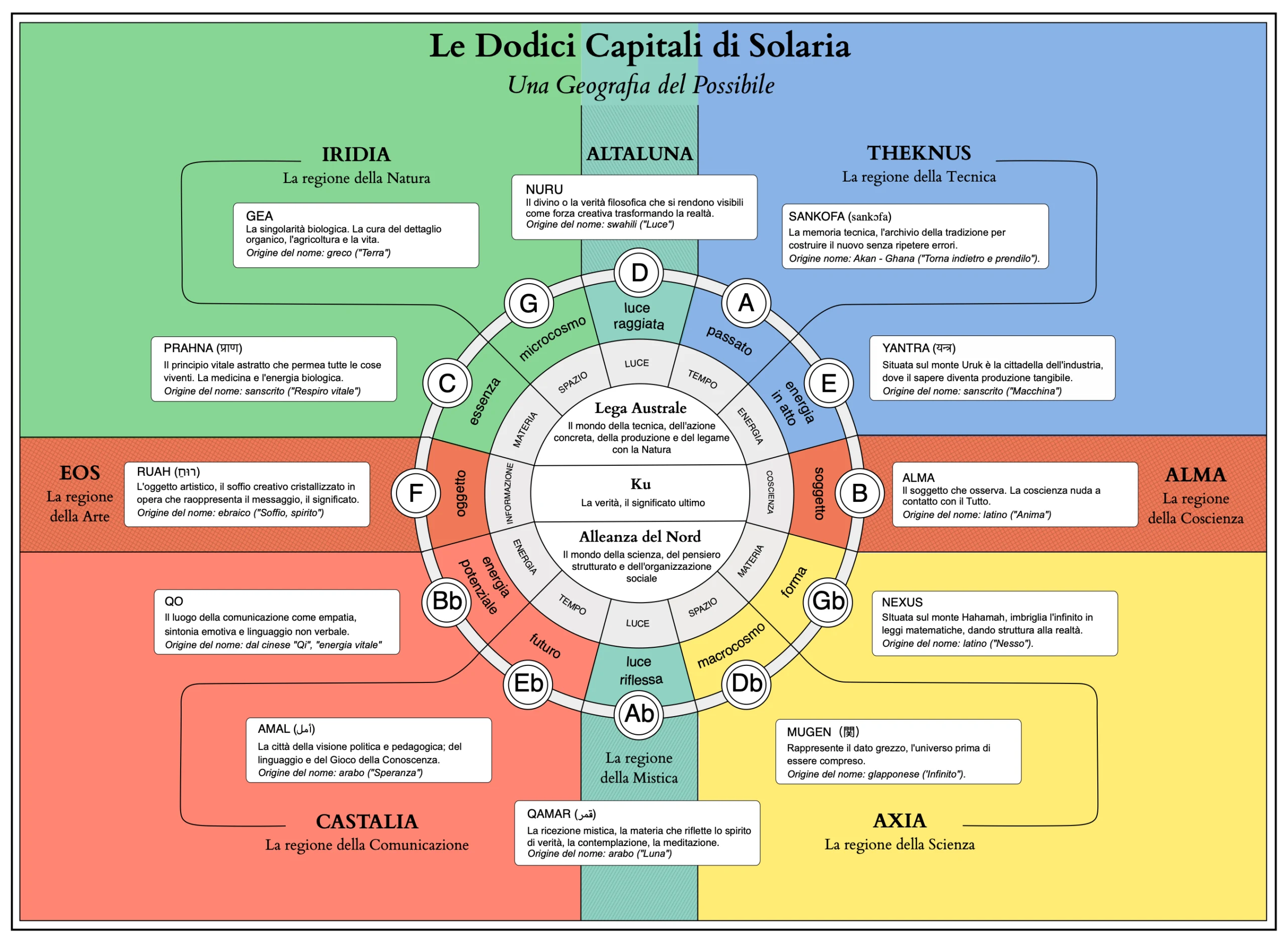
The complete picture: the twelve capitals on the circle of fifths, with the element each one guards, the nation it belongs to, and the coalition it is part of.
Intervals of action
The musical relationship between the two capitals of the same nation is, with a single exception, a perfect fifth: the combination that produces the most stable sound between two different notes. Just as in a musical interval each of the two notes owes its identity to the other, so every nation lives within the unstable balance between its two poles.
| Nation | Pair | Interval |
|---|---|---|
| Iridia | C – G | perfect fifth |
| Theknus | A – E | perfect fifth |
| Castalia | B♭ – E♭ | perfect fifth |
| Axia | D♭ – G♭ | perfect fifth |
| Altaluna | D – A♭ | tritone |
The Capitals of the South
The Southern League is formed by the territories of Iridia and Theknus.
The capitals of Iridia, the region of nature, are Prahna and Gea. Prahna is the vital breath that permeates everything, the invisible principle that makes life possible; Gea embodies the solidity of the earth, attention to the organic and biological world, care for what grows. Together they represent a nature that is at once body and breath, form and flow.
Theknus, the region of technique, is structured around Sankofa and Yantra. Sankofa is technical memory, the archive, the tradition that builds upon the experience of the past; Yantra is the device, the mechanism, the citadel of industry where knowledge becomes tangible production. Technique thus oscillates between memory and project, between repetition and innovation.
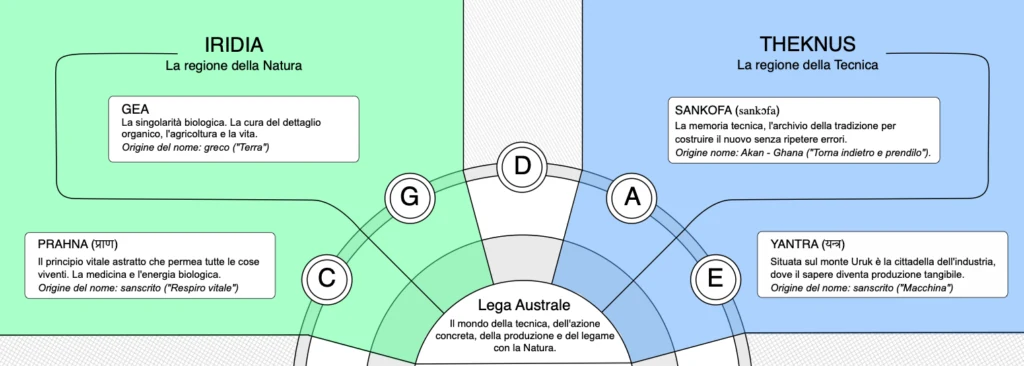
The southern sector of the wheel: Iridia and Theknus with their four capitals.
The Capitals of the North
The Northern Alliance is formed by Castalia and Axia.
Castalia, the region of communication, lives between Qo and Amal. Qo is the domain of empathy, of affective and emotional resonance, of the earliest forms of non-verbal language: the condition that makes encounter possible before communication organizes itself into stable, narrative structures. Amal is hope, the pedagogical vision that transforms the future into a shared aspiration.
Axia, the territory of science, hosts Mugen and Nexus. Mugen is raw infinity, the universe before being understood, that which exceeds any system of thought; Nexus is the bond, the network of physical and mathematical laws that gives structure to the infinite. The dialogue between the two cities embodies the limit of reason and, at the same time, its necessity.
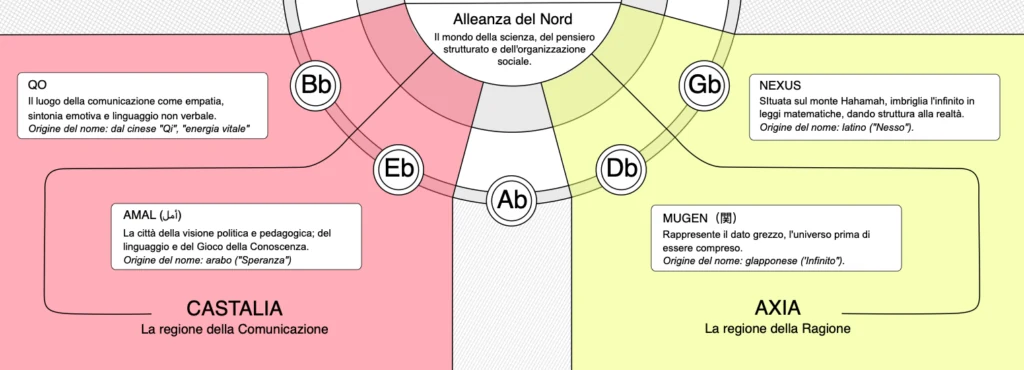
The northern sector: Castalia and Axia with their four capitals.
Altaluna
Altaluna, the region of mysticism, lives divided: its two capitals, Nuru and Qamar, are found respectively in the Southern League and the Northern Alliance.
Qamar signifies reflection, contemplation, matter becoming a mirror of the spirit; Nuru is the divine made visible as a creative force in reality. Altaluna is thus in tension between action and contemplation, between inner withdrawal and the irruption of the sacred into the world.
The interval between the two capitals is not a fifth, but a tritone: the symbolic interval, the reunion of two distinct parts that together form the whole. In music the tritone is symmetrical with respect to itself, and its extremes can be inverted without its nature changing; this is what happens to Altaluna’s two dimensions, where action and contemplation are nothing but the two forms assumed by the same mystical experience.
Alma and Eos
Alma and Eos each have only one capital, because they represent unity: a unity yet to be recomposed.
Alma is the eponymous capital of the island of consciousness, the sole point of arrival in a land surrounded by the Horizon of the Manifold. Ruah, the capital of Eos, is the breath, the creative spirit that crystallizes into a work: here meaning becomes matter in the various arts, from music to poetry, from sculpture to theater.
Alma and Ruah also form a tritone, since the human soul and art, consciousness and information, the question and answer of human experience find themselves in an inevitable and symbiotic relationship. Between the two territories there is no linear continuity, but a leap that must be made by crossing through the other nations: the work of art, in Solaria, is the attempt to cross the Orizzonte del Molteplice, a gesture that translates the unity of consciousness into the multiplicity of artistic experience, accepting the loss this entails.
The Meaning of the System
The distance between Alma and Eos is what makes the rest of Solaria possible: without Alma’s question there would be no need to build, study, communicate, perceive, or pray; and without Eos’s imperfect answer, consciousness would remain closed in on itself. The tritone that unites them is thus the deepest vibration of the entire system, the one in which the human being is recognized both as an open question and as a creative gesture.
The experience of the world is therefore always incomplete and mediated: it is born in consciousness, takes form in art, and returns to consciousness transformed, but never resolved once and for all.
If one day the war of Solaria should end, the island will not describe a pacified world, but a tuned world: a geography of the possible, in which meaning does not emerge from the elimination of opposites, but from their continuous dialogue.
Related Entries
The Seven Nations
Southern League
Northern Alliance
Symbolic Meridians
Symbolic Geography
Chromatic Total and the Cycle of Fifths
Tritone
Pentatonic Scale